
In-depth read
Rosemary Oil for Hair Growth: 700 Years of Use, One Trial
You've seen the videos and maybe bought the bottle. Here's what rosemary oil has been shown to do for hair, what it hasn't, and why the idea is centuries old.
Reviewed by Steve8 min read
The short version
- The main evidence is one 2015 trial of 100 people: rosemary oil and a lower-strength minoxidil solution gave similar hair count gains at six months, with no significant change at three months and no untreated group [1].
- The strongest controlled result involving rosemary is a 1998 alopecia areata trial of a four-oil blend: 44% improved vs 15% with plain oil, so rosemary's own share is unknown [2].
- Rosemary has been used in hair washes since at least the early 1300s, and the oil can cause an itchy allergic rash in some people [7][11].
Maybe it started with a video: someone parting their hair to show new baby hairs, a little bottle of rosemary oil beside the sink. You noticed a wider part of your own, or a thinner ponytail, and now you want to know if rosemary oil for hair growth is real or just another thing to buy.
Here's the straight answer. The best human evidence is one 2015 trial in which rosemary oil and a lower-strength minoxidil solution produced similar gains in hair count after six months, with no significant change in either group at three months [1]. There was no untreated group, so the trial can't tell us how much of that change came from the oil itself [1].
Below you'll find where the rosemary idea comes from (it's older than social media by about seven centuries), what each study really measured, what can irritate a scalp, and why the calendar matters more than any before-and-after video.
100
People with pattern hair loss in the only trial comparing rosemary oil with minoxidil, split 50 and 50[1]
6 months
Before that trial found more hair in either group; at 3 months there was no significant change[1]
1
Rosemary oil trial a 2025 analysis of 24 hair loss trials could include[4]
Does rosemary oil for hair growth really work?
It might, but the proof is thin. In the 2015 trial, 100 people with pattern hair loss (described in a later review as men aged 18 to 49) were randomly assigned to rosemary oil or a lower-strength minoxidil solution for six months [1][5]. Hair was counted on standardized close-up photos at the start, at three months and at six months [1].
At three months, neither group had a significant change in hair count [1]. At six months, both groups had more hairs than at the start, and the difference between the two groups wasn't significant [1]. Scalp itching rose in both groups, and it was more frequent with minoxidil [1].
Now the catch, and it's a big one. Without a group that used nothing, or a plain oil, you can't separate the treatment from everything else that happens over six months. A tie with the milder version of a medicine is not the same as a win. The trial was also small, and as of 2025 no second trial of rosemary oil had been added to the evidence [1][4].
Where did the rosemary-for-hair idea come from?
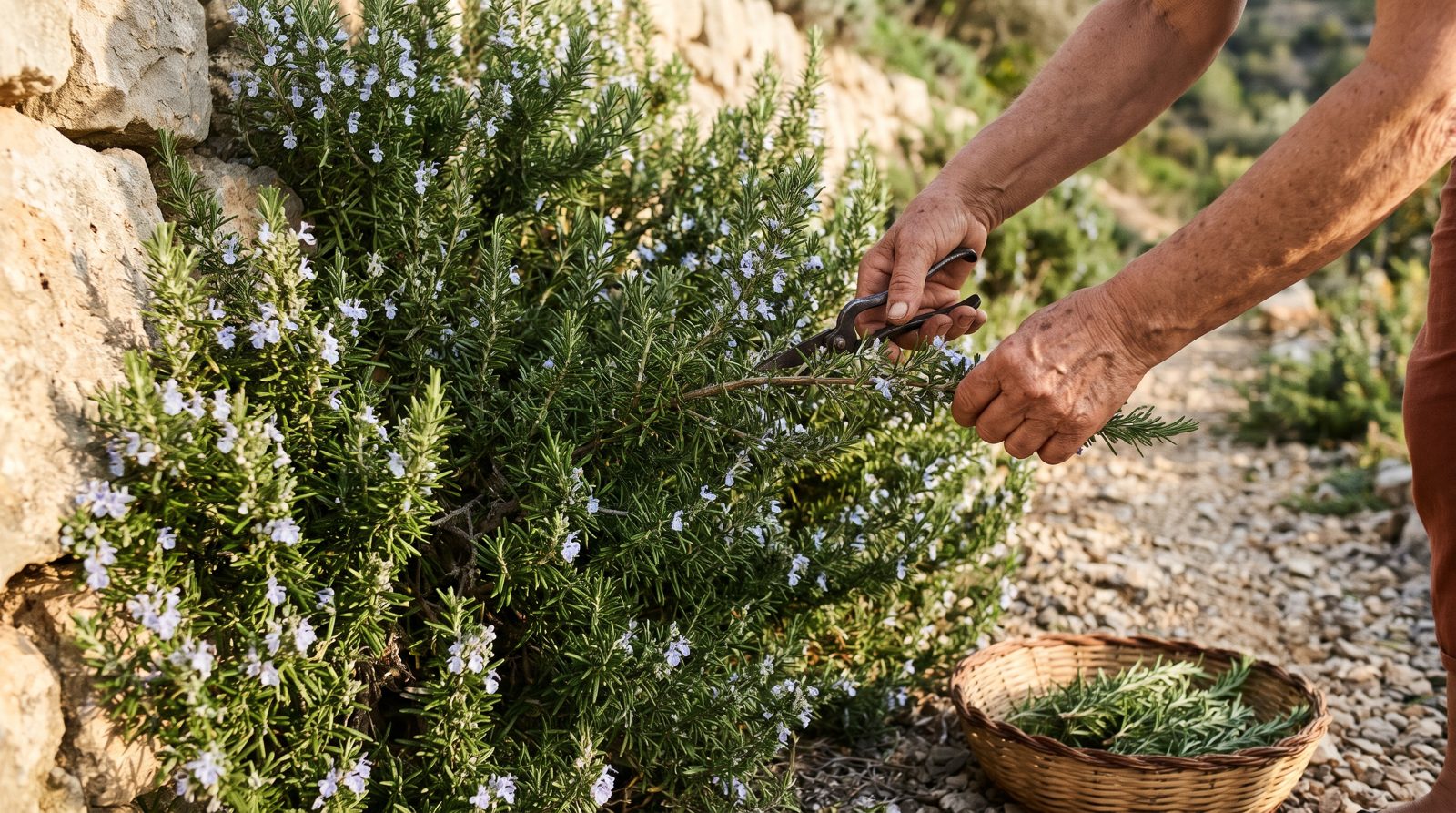
Rosemary grows wild around the Mediterranean, and people have used it for millennia: dried rosemary has been found in Egyptian tombs from as far back as 3000 BC [5]. Its use on hair is documented later, in European kitchen and medicine books.
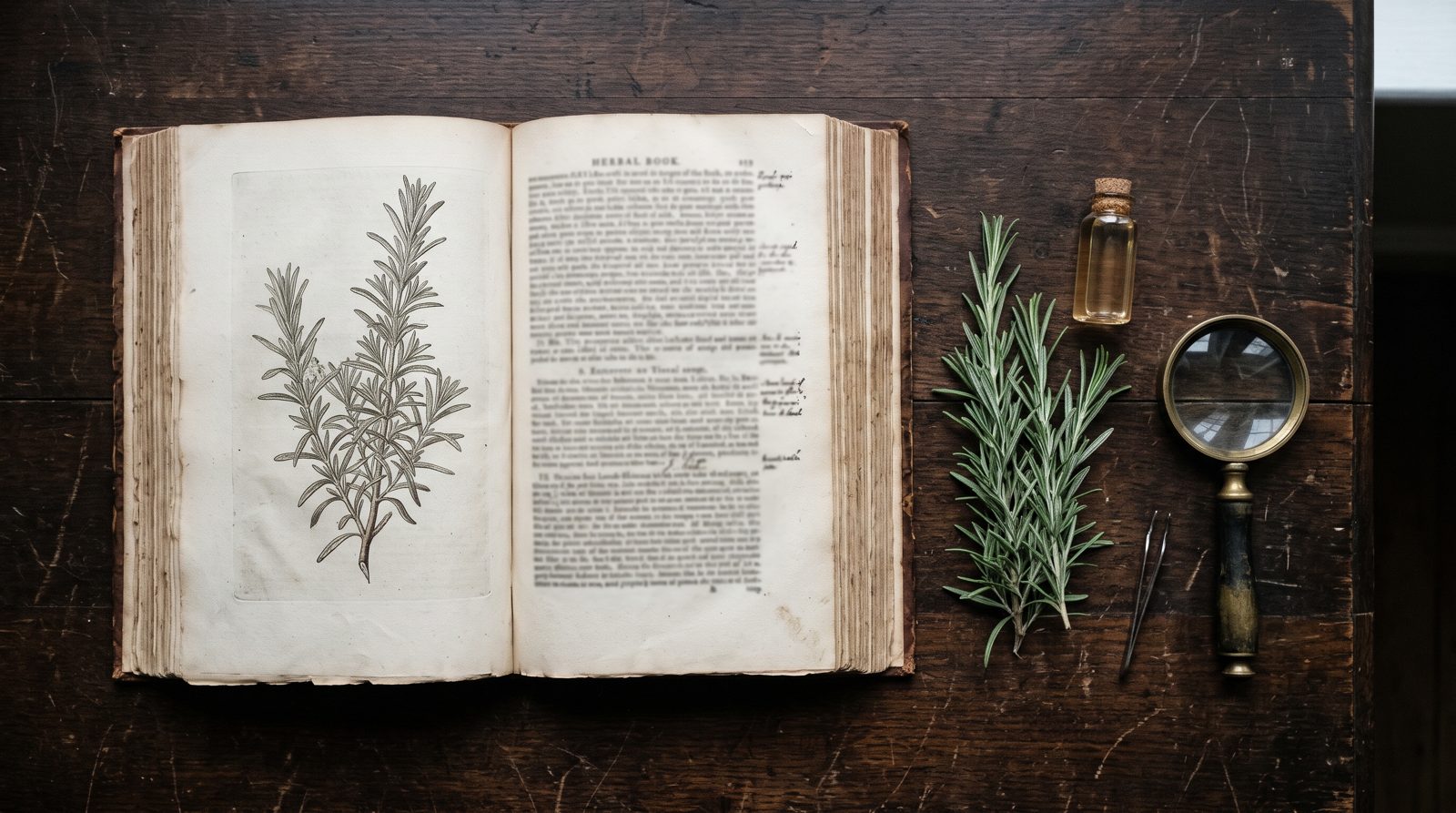
An early-14th-century notebook kept by a Venetian merchant, known as the Zibaldone da Canal, lists rosemary boiled in white wine as a wash that "will make your face white and beautiful, and the hair beautiful" [7]. By the early 20th century, the English herbalist Maud Grieve was describing rosemary as an ingredient in hair lotions and hair washes, and as a remedy against dandruff [6].
“stimulating the hair-bulbs to renewed activity and preventing premature baldness”
That was the belief of her time, written down without any measurements behind it. The second life of the idea came online. A 2023 dermatology review looked at the hair remedies spreading on TikTok, rosemary oil among them [8]. In a 2025 survey of 994 people in Saudi Arabia, mostly young women, 58.7% said they had used rosemary, mostly the oil, as a treatment [9].
About 3000 BC
Dried rosemary placed in Egyptian tombs
Used to perfume the dead, not for hair [5].
Early 1300s
A Venetian merchant's notebook
Rosemary boiled in wine as a wash for face and hair [7].
1931
A Modern Herbal
Maud Grieve lists rosemary in hair lotions and hair washes [6].
2013
First lab and mouse study on hair
A leaf extract helped hair regrow in mice treated with testosterone [3].
2015
The one head-to-head human trial
100 people, six months, rosemary oil vs a minoxidil solution [1].
2023
Dermatologists look at TikTok remedies
Rosemary oil, rice water and onion juice reviewed [8].
2025
A pooled analysis of 24 trials
Still only one rosemary oil trial to include [4].
Why might rosemary help hair, in theory?
The idea is that rosemary acts on the same hormone pathway as some hair loss medicines. In a 2013 lab study, a rosemary leaf extract blocked 82.4% to 94.6% of the activity of 5-alpha reductase, the enzyme that turns testosterone into the stronger hormone tied to pattern hair loss [3][5]. The same extract helped hair regrow in mice whose regrowth had been slowed with testosterone [3].
That's a real finding, but it was in a dish and in mice, with a leaf extract rather than the oil people buy [3]. Researchers also suggest rosemary may calm inflammation and fight fungi on the scalp, and may improve blood flow in tiny vessels [1][4]. None of these ideas has been confirmed on human scalps.
What do the studies on rosemary oil really show?
Put side by side, the studies are few, small and mixed in what they tested. The strongest controlled result involving rosemary isn't in pattern hair loss at all.
| Study | Who | Compared with | What it found | The catch |
|---|---|---|---|---|
| Panahi, 2015 [1] | 100 people with pattern hair loss, 6 months | A minoxidil solution | Both groups gained hair at 6 months, none at 3; no difference between them | No untreated group, one small trial |
| Hay, 1998 [2] | 86 people with alopecia areata, 7 months | Plain carrier oils | 44% improved vs 15% | Blend of four oils; rosemary's share unknown |
| Murata, 2013 [3] | Mice and cells | Lab and animal comparisons | Extract blocked a hair loss enzyme, helped regrowth in mice | Not people, not the oil |
The 1998 Scottish trial tested a massage blend of thyme, rosemary, lavender and cedarwood oils in carrier oils against carrier oils alone, in people with alopecia areata, a condition that causes patchy hair loss [2]. Dermatologists who didn't know the groups judged the photos [2].
- Essential oil blend44%
- Carrier oils only15%
19 of 43 people vs 6 of 41. The blend contained thyme, rosemary, lavender and cedarwood.
Source: [2] Archives of Dermatology (PubMed), 1998
Show the numbers
| Essential oil blend | 44% |
|---|---|
| Carrier oils only | 15% |
That's a clear difference in a well-run trial. But four oils were mixed, so no one knows what rosemary added, and it was one trial from 1998 [2]. Notice the 15% too: some patches improved with plain oil alone [2].
How can you tell if rosemary oil is really changing your hair?
Give any change months, not weeks. In the 2015 trial, careful counts on standardized photos found no significant change at three months, in either group [1]. A short video filmed after a few weeks is unlikely to show the oil's effect, whatever it is.
The mirror isn't much help either. Lighting, a fresh wash and how you part your hair all change what you see, and daily shedding goes up and down on its own (here's what normal shedding in the shower looks like). The trials that found anything compared the same scalp areas, photographed the same way, months apart [1][2].
Is rosemary oil safe for your scalp?
For most people it's mild, but it isn't harmless for everyone. A review of published cases found that rosemary, both the plant and its extracts, can cause allergic contact dermatitis, an itchy rash where it touches skin, and that cases may be missed because they're mistaken for other rashes [11]. Two of the reported cases involved cross-reactions between rosemary and thyme [11].
Essential oils are concentrated. Dermatologists advise against putting neat, undiluted oils directly on skin, because that can lead to allergy [12]. Itching, redness and scaling where an oil was applied are the usual signs [12]. A 2025 review of online misinformation about hair loss also listed rosemary oil among the remedies being touted without good evidence [10].
If pattern hair loss is what you're seeing, medicines with much more research behind them exist, and a dermatologist can tell you what's causing your hair loss and what fits your situation. Some of those options need a prescription, and a doctor decides.
If you've been reaching for that bottle every night, you haven't done anything foolish: you've joined a very old habit. Just give yourself honest information to judge it by, and a dermatologist's eye if something worries you. Your hair deserves both patience and facts.
Questions people ask
How long does rosemary oil take to work on hair?
No one knows for sure. In the only trial comparing rosemary oil with minoxidil, 100 people showed no significant change in hair count at three months; both groups had more hair at six months [1]. That trial had no untreated group, so it can't say how much of the change came from the oil itself.
Is rosemary oil better than minoxidil?
No study shows that. One 2015 trial of 100 people found similar hair count gains with rosemary oil and a lower-strength minoxidil solution after six months, with more scalp itching on minoxidil [1]. It was small and had no untreated group. A 2025 analysis of 24 trials found just that one rosemary oil study to include [4].
Can rosemary oil cause hair loss or a rash?
A review of published cases found rosemary can cause allergic contact dermatitis, an itchy rash where it touches skin, and that it may be underdiagnosed [11]. Dermatologists also advise against putting undiluted essential oils directly on skin, since that can lead to allergy [12]. A rash or burning scalp is a reason to stop and see a dermatologist.
Does rosemary oil help alopecia areata?
One 1998 trial of 86 people with alopecia areata found that 44% of those massaging a blend of thyme, rosemary, lavender and cedarwood oils improved, against 15% using plain carrier oils [2]. Because four oils were mixed, rosemary's own effect is unknown, and the trial hasn't been repeated. Alopecia areata needs a dermatologist's care.
Sources
- 1.Rosemary oil vs minoxidil 2% for the treatment of androgenetic alopecia: a randomized comparative trial. Skinmed (PubMed), 2015.
- 2.Randomized trial of aromatherapy. Successful treatment for alopecia areata. Archives of Dermatology (PubMed), 1998.
- 3.Promotion of hair growth by Rosmarinus officinalis leaf extract. Phytotherapy Research (PubMed), 2013.
- 4.Relative Efficacy of Conventional Monotherapies and Select Nonconventional, Over-the-Counter Products for Male Androgenetic Alopecia: A Network Meta-Analysis Study. Journal of Cosmetic Dermatology (PMC), 2025.
- 5.An Overview of Commonly Used Natural Alternatives for the Treatment of Androgenetic Alopecia, with Special Emphasis on Rosemary Oil. Clinical, Cosmetic and Investigational Dermatology (PMC), 2024.
- 6.Rosemary, from A Modern Herbal by Maud Grieve. Botanical.com reproduction of A Modern Herbal (1931), 1931.
- 7.23 Medieval Uses for Rosemary. Medievalists.net, 2016.
- 8.The Evidence Behind Topical Hair Loss Remedies on TikTok. Cutis (PubMed), 2023.
- 9.Hair greying associated with rosemary use: a cross-sectional study in Saudi Arabia. Dermatology Reports (PMC), 2025.
- 10.A Qualitative Review of Misinformation on Alopecia. Skin Appendage Disorders (PMC), 2025.
- 11.Rosmarinus officinalis L. as cause of contact dermatitis. Allergologia et Immunopathologia (PubMed), 2014.
- 12.Allergic contact dermatitis to essential oils. DermNet, 2020.
About this article
Researched and drafted with AI help, then checked and approved by Steve before it went live. Steve: Founder @ Folliclever. Every number links to its source above.
This is general information, not medical advice, and Folliclever doesn't diagnose. For anything about your own hair or scalp, talk to a dermatologist.
Stop guessing in the mirror. Know where your hair stands.
Take up to 4 phone photos in minutes. Get honest estimates of your hair density and thickness—and track real change over time.
Start my 1 free scanYour first scan is free. Sign in with Google—no password, only you see your photos. Not a diagnosis.
Keep reading

Traditional hair care
Scalp Massage for Hair Growth: An Old Ritual, Two Small Studies
Rubbing your scalp feels like doing something about a wider part. Here's what the research found, and the family ritual the habit comes from.
In-depth read · 8 min · November 20, 2026

Myths and facts
Does Wearing a Hat Cause Hair Loss?
Beanie season is here, and so is the old worry that hats make you go bald.
Quick read · 2 min · November 21, 2026

Sleep, stress and food
Does Stress Cause Hair Loss? What the Research Shows
A rough few months, and now more hair in the drain. Here's how stress and shedding are really linked, and why the timing fools so many people.
In-depth read · 8 min · November 18, 2026