
In-depth read
Scalp Massage for Hair Growth: An Old Ritual, Two Small Studies
Rubbing your scalp feels like doing something about a wider part. Here's what the research found, and the family ritual the habit comes from.
Reviewed by Steve8 min read
The short version
- No study has shown scalp massage increases the number of hairs; the only controlled trial, in nine men without hair loss, found strands about 8% thicker on the massaged side [1].
- In a 2019 survey, 68.9% of people with thinning said their loss stabilized or reversed, but results were self-judged, with no comparison group [2].
- Scalp massage lowered cortisol and blood pressure in a small 10-week study, which makes stress relief its best-supported benefit [3].
- The word shampoo comes from a Hindi and Urdu word meaning to press or massage, and when it entered English in 1762 it meant massage, not washing [6].
You read somewhere that rubbing your scalp every day can wake up sleepy follicles. It costs nothing, it feels good, and when your part looks wider than it used to, doing something tonight is a relief. So does scalp massage for hair growth actually work?
Honest answer: it hasn't been shown to grow more hair. The one controlled study, in nine Japanese men without hair loss, found strands got slightly thicker on the massaged side, while the number of hairs there dipped at 12 weeks [1]. A larger survey found 68.9% of people with thinning said their loss slowed or reversed, but nobody measured their hair and there was no comparison group [2].
Below: where the habit comes from (the word on your shampoo bottle is part of the story), what those studies really found, why stress may be the more believable link, and how to tell a real change from a bad-light day.
Where does scalp massage come from?
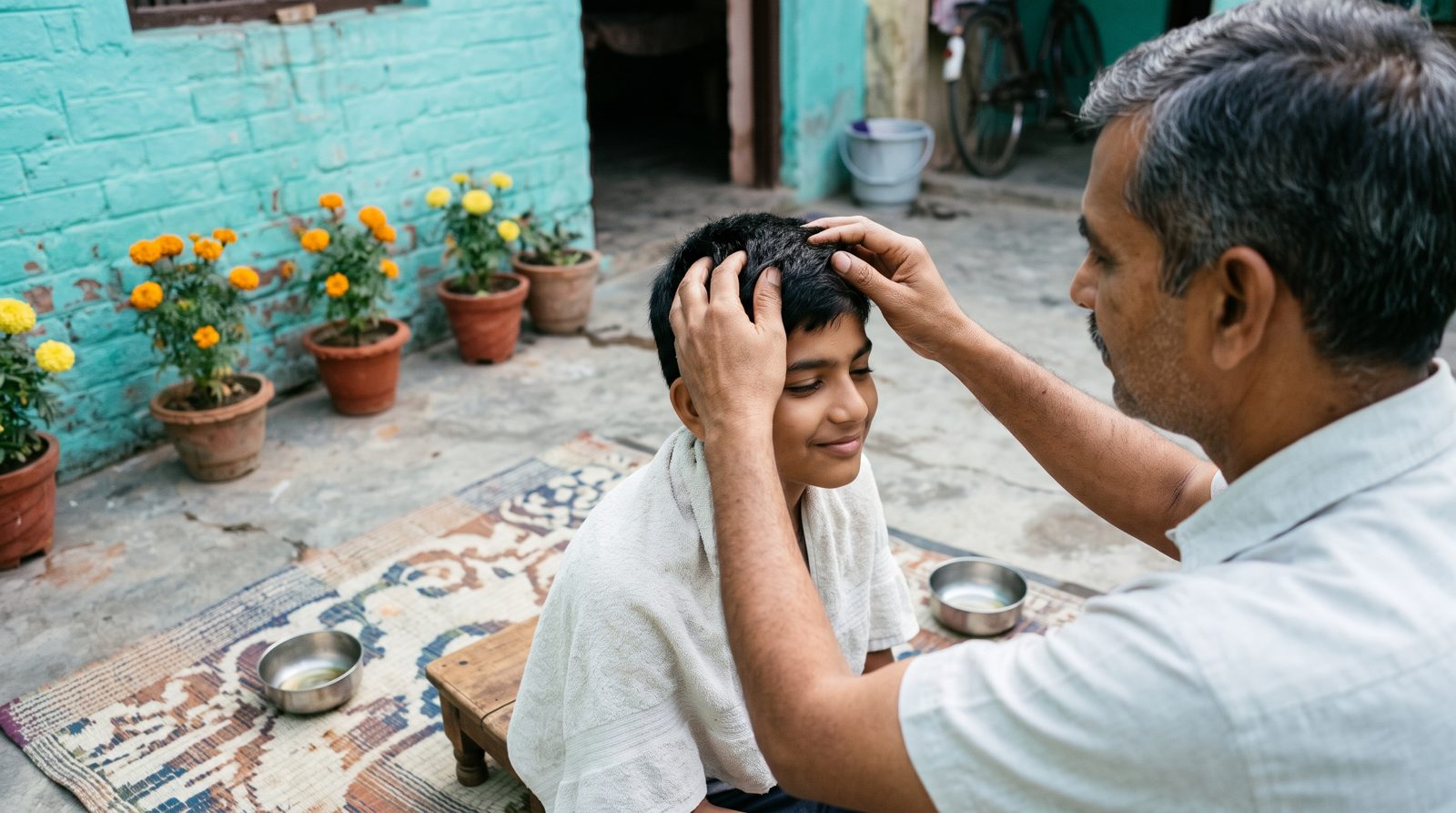
Long before it was a wellness trend, it was a family ritual. In many South Asian homes, a weekly oil massage of the scalp, often called champi, is something mothers, fathers and grandmothers give children, frequently on a Sunday [8]. Writer Varsha Patel describes it in her family as thel maalish, passed from her grandmother to her mother, with coconut oil worked in by fingers and palms [9].
“I remember my mom oiling my hair weekly, including a massage, and placing it in a braid.”
Here's the part almost nobody mentions: the English word shampoo comes from Hindi and Urdu cā̃po, from a verb meaning "to press, massage" [6]. When it entered English in 1762, it meant massage, a sense dictionaries now list as archaic [6]. Washing came later.
The man who made it famous in Britain was Sake Dean Mahomed, born in Patna, India, in 1759 [7]. He arrived in Brighton in 1814 and offered "Shampooing with Indian Oils," a type of aromatherapy massage, alongside a steam bath [7]. He was later appointed shampooing surgeon to King George IV and King William IV [7].
For generations
Champi in South Asian homes
A weekly scalp massage with oil, given by parents and grandparents to children, often on Sundays [8][9].
1759
Sake Dean Mahomed is born in Patna, India
He would later carry the practice to England [7].
1762
"Shampoo" enters English
Its first known use in English means to massage [6].
1814
Mahomed arrives in Brighton
He offers shampooing with Indian oils, a massage, alongside a steam bath [7].
Later
A royal title
He is appointed shampooing surgeon to kings George IV and William IV [7].
Today
Shampoo means washing
The massage meaning is listed as archaic [6]. The ritual itself lives on in many families [9].
Why might the tradition care for hair? The idea, as families describe it, is nourishment and closeness: time with someone's hands on your head [8][9]. In theory, oil coats the strand, and slow, gentle handling means less tugging. That's a case for hair that breaks less, which is a different claim from hair that grows more.
Does scalp massage for hair growth really work?
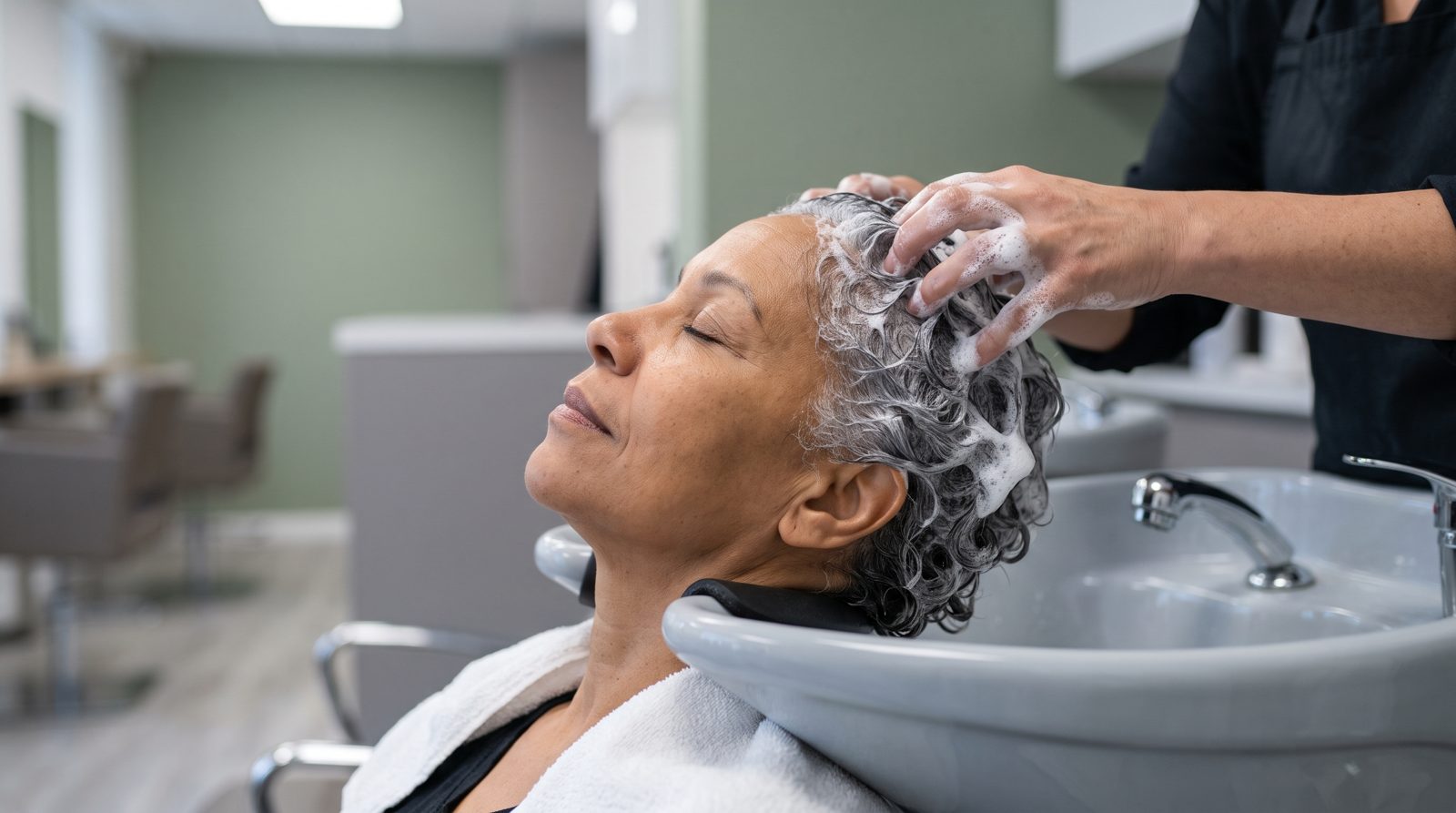
No study has shown it increases the number of hairs. The best-known trial, from 2016, followed nine healthy Japanese men aged 25 to 46 with no obvious hair loss [1]. One side of each man's scalp was massaged with a handheld electric device for 24 weeks; the matching spot on the other side was left alone as the comparison [1].
9
men in the only controlled study, none with obvious hair loss[1]
0.085→0.092
strand thickness in mm on the massaged side, about 8% thicker[1]
24 weeks
length of the study; growth speed did not change[1]
Hair on the massaged side got thicker, from 0.085 mm to 0.092 mm [1]. That's 7 thousandths of a millimeter per strand. Growth speed didn't change [1]. And the hair count on that side fell at 12 weeks, from about 164 to about 156 hairs per square centimeter, a drop the authors reported as significant [1].
- Start164 hairs/cm²
- 12 weeks156 hairs/cm²
Nine men without hair loss. The unmassaged side showed no significant change.
Source: [1] Eplasty (Koyama et al.), 2016
Show the numbers
| Start | 164 hairs/cm² |
|---|---|
| 12 weeks | 156 hairs/cm² |
Then there's who paid. The study was partly funded by a Japanese company, and two of its five authors worked there [1]. That doesn't make it wrong, but it's one small, partly industry-funded study that hasn't been repeated in people who are actually thinning.
What about people who are already losing hair?
The only data come from a 2019 survey. Researchers emailed 1,899 people with self-assessed pattern hair loss who had bought a guide and video on a structured hand-massage routine; 340 answered, and 327 said they had tried it [2]. Most were men: 29 were women [2].
Of those who rated their hair, 37.3% said their loss had stabilized and 31.7% reported slight or significant regrowth [2]. People who reported more daily massage time reported better results [2]. The catches are big: no control group, hair changes judged by the participants themselves, diagnoses never confirmed by a dermatologist, and a 19% response rate [2]. The lead author also runs a commercial website about these ideas [2].
| Study | Who | What it found | The catch |
|---|---|---|---|
| 2016 trial [1] | 9 men without hair loss, 24 weeks | Thicker strands; no change in growth speed | Tiny, partly industry-funded; hair count dipped at 12 weeks |
| 2019 survey [2] | 327 people with self-assessed thinning | 68.9% said loss stabilized or hair regrew | Self-reported, no control group, low response |
| 2016 stress study [3] | 34 women office workers, 10 weeks | Lower stress hormones and blood pressure | Didn't measure hair at all |
Could scalp massage help by lowering stress?
Possibly, and this is the more believable route. In a 2016 study, 34 women office workers were split into two massage groups and a no-massage group for 10 weeks [3]. In both massage groups, the stress hormone cortisol fell by roughly a third (from 23.4 to 16.3, and from 24.2 to 15.3), and blood pressure dropped too; heart rate didn't change significantly [3].
Why that matters for hair: a big stressor such as an illness, surgery or childbirth can trigger heavy shedding, and most people notice it a few months later [4]. But no study has tested whether massage prevents that kind of shedding. So it's fair to say massage can calm you down. It's not yet fair to say that saves hair.
How would you know if it's doing anything?
Not by looking in the mirror. The change in the 2016 study was a few thousandths of a millimeter per hair [1], far below what the eye can see, and lighting, a fresh wash or a new part can make the same hair look thin one day and full the next.
Hairs coming loose during a massage aren't a verdict either. Losing 50 to 100 hairs a day is normal [4], and many of those come out whenever hair is handled. If you're counting them, here's how much shedding in the shower is normal. The only fair test is the same spot, measured the same way, before and after a few months.
Can scalp massage hurt your hair?
Gentle massage is unlikely to cause harm, but rough handling can. Dermatologists advise massaging shampoo into the scalp rather than scrubbing the lengths, pressing hair dry instead of rubbing it, and avoiding tugging when styling [5]. They also call brushing 100 strokes a day a myth [5].
If changing how you care for your hair doesn't help, a board-certified dermatologist can look for the real cause [5].
If someone in your family used to give you champi on Sunday mornings, that ritual was never really about a hair count. It was about care, time and attention, a parent's hands. That part is worth keeping. For the hair itself, let evidence and a steady measurement, rather than hope or worry, tell you what's changing.
Questions people ask
Can scalp massage regrow a receding hairline?
There's no good evidence it can. The only controlled study was in men without hair loss and found thicker strands but no more hairs [1]. In a 2019 survey, 31.7% of people with self-assessed thinning reported some regrowth, but there was no comparison group and nobody measured their hair [2]. A dermatologist can explain what's causing the change.
Is it normal to lose hair when massaging your scalp?
Yes, some loose hairs are normal. People typically shed 50 to 100 hairs a day [4], and many come out whenever hair is washed, brushed or handled. Seeing them on your fingers doesn't mean massage is causing hair loss. Clumps, patches or shedding that stays heavy for months are reasons to see a dermatologist [4].
Is a scalp massager better than using your fingers?
No study has compared them. The 2016 trial used a handheld electric massager and found slightly thicker hair on the massaged side [1], while the 2019 survey asked about massage by hand [2]. Neither was designed to rank methods. Dermatologists do advise gentle handling, since tugging and rough scrubbing can damage hair [5].
Does scalp massage reduce stress?
Some evidence says yes. In a 2016 study of 34 women office workers, those who had scalp massages for 10 weeks saw cortisol, a stress hormone, fall by roughly a third, and their blood pressure dropped as well [3]. The study was small and didn't measure hair, so any benefit for stress-related shedding is untested.
Sources
- 1.Standardized Scalp Massage Results in Increased Hair Thickness by Inducing Stretching Forces to Dermal Papilla Cells in the Subcutaneous Tissue. Eplasty (Koyama et al.), 2016.
- 2.Self-Assessments of Standardized Scalp Massages for Androgenic Alopecia: Survey Results. Dermatology and Therapy (English and Barazesh), 2019.
- 3.The effect of a scalp massage on stress hormone, blood pressure, and heart rate of healthy female. Journal of Physical Therapy Science (Kim, Kim and Ko), 2016.
- 4.Do you have hair loss or hair shedding?. American Academy of Dermatology.
- 5.10 hair care habits that can damage your hair. American Academy of Dermatology.
- 6.Shampoo (definition and etymology). Merriam-Webster Dictionary.
- 7.Sake Dean Mahomed: Brighton resident and Regency entrepreneur. Brighton & Hove Museums.
- 8.Why hair oiling is having a major global moment. Harper's Bazaar India (Meghna Sharma), 2023.
- 9.The South Asian tradition of scalp oiling is about family, community and passing down stories, not just shiny hair. Stylist (Varsha Patel), 2022.
- 10.What is hair oiling? Everything to know about the centuries-old Ayurvedic practice. Harper's Bazaar India (Anvita Reddy), 2025.
About this article
Researched and drafted with AI help, then checked and approved by Steve before it went live. Steve: Founder @ Folliclever. Every number links to its source above.
This is general information, not medical advice, and Folliclever doesn't diagnose. For anything about your own hair or scalp, talk to a dermatologist.
Stop guessing in the mirror. Know where your hair stands.
Take up to 4 phone photos in minutes. Get honest estimates of your hair density and thickness—and track real change over time.
Start my 1 free scanYour first scan is free. Sign in with Google—no password, only you see your photos. Not a diagnosis.
Keep reading
Traditional hair care
Rosemary Oil for Hair Growth: 700 Years of Use, One Trial
You've seen the videos and maybe bought the bottle. Here's what rosemary oil has been shown to do for hair, what it hasn't, and why the idea is centuries old.
In-depth read · 8 min · November 19, 2026
Myths and facts
Does Wearing a Hat Cause Hair Loss?
Beanie season is here, and so is the old worry that hats make you go bald.
Quick read · 2 min · November 21, 2026
Sleep, stress and food
Does Stress Cause Hair Loss? What the Research Shows
A rough few months, and now more hair in the drain. Here's how stress and shedding are really linked, and why the timing fools so many people.
In-depth read · 8 min · November 18, 2026